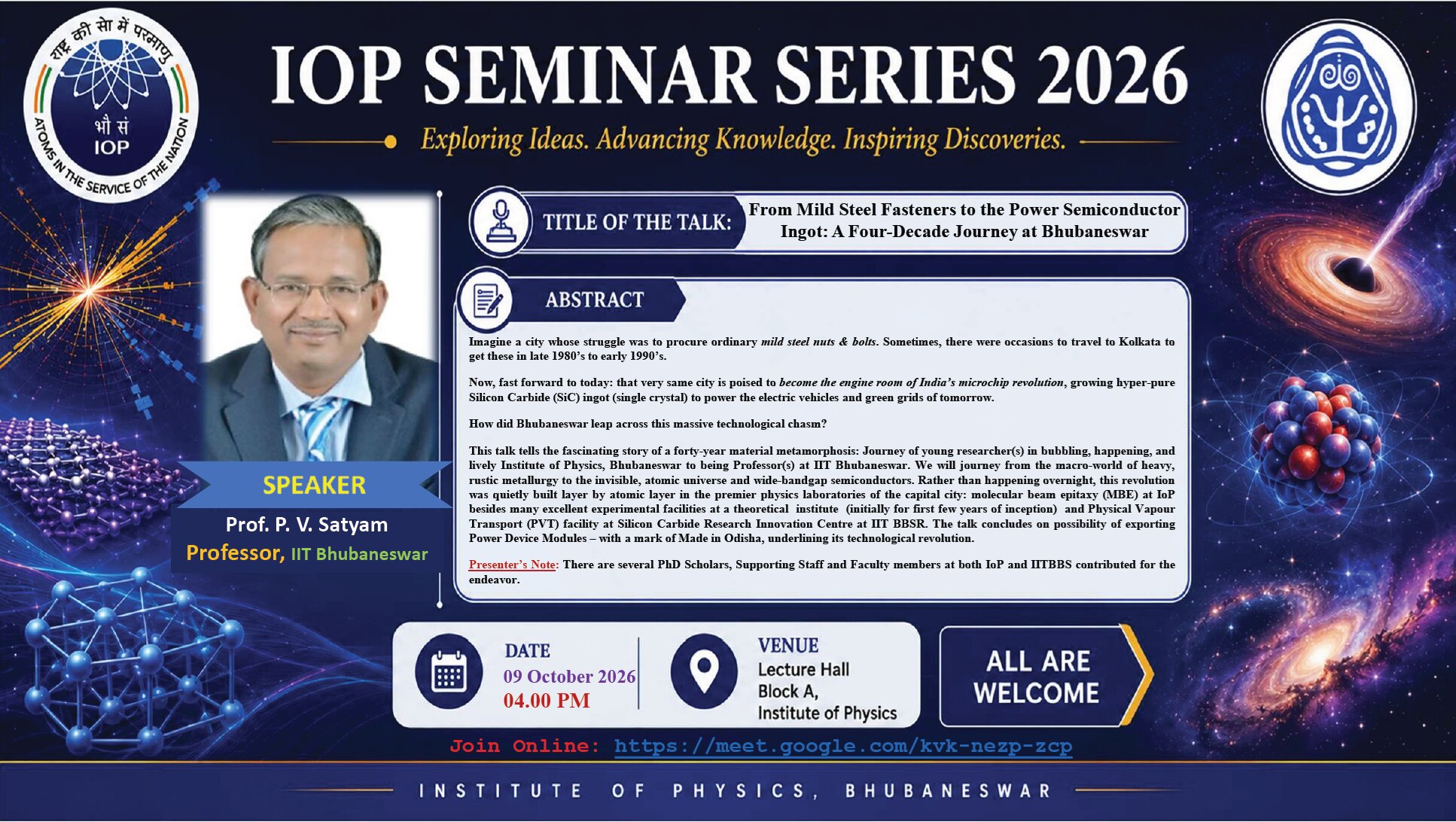
Prof. P. V. Satyam, Indian Institute of Technology, Bhubaneswar
Seminar
Lecture Hall, Block-A, Institute of Physics, Bhubaneswar
Document Date: 01/10/2026
Mild Steel Fasteners to the Power Semiconductor Ingot: A Four-Decade Journey
Mild Steel Fasteners to the Power Semiconductor Ingot: A Four-Decade Journey
Abstract:
Imagine a city whose struggle was to procure ordinary mild steel nuts & bolts. Sometimes, there were occasions to travel to Kolkata to get these in late 1980’s to early 1990’s.
Now, fast forward to today: that very same city is poised to become the engine room of India’s microchip revolution, growing hyper-pure Silicon Carbide (SiC) ingot (single crystal) to power the electric vehicles and green grids of tomorrow.
How did Bhubaneswar leap across this massive technological chasm?
This talk tells the fascinating story of a forty-year material metamorphosis: the journey of young researcher(s) in the bubbling, happening, and lively Institute of Physics, Bhubaneswar, to being Professor(s) at IIT Bhubaneswar. We will journey from the macro-world of heavy, rustic metallurgy to the invisible, atomic universe and wide-bandgap semiconductors. Rather than happening overnight, this revolution was quietly built layer by atomic layer in the premier physics laboratories of the capital city: molecular beam epitaxy (MBE) at IoP, besides many excellent experimental facilities at a theoretical institute (initially for the first few years of inception) and Physical Vapour Transport (PVT) facility at Silicon Carbide Research Innovation Centre at IIT BBSR. The talk concludes on the possibility of exporting Power Device Modules – with a mark of Made in Odisha, underlining its technological revolution.
Presenter’s Note: There are several PhD Scholars, Supporting Staff and Faculty members at both IoP and IITBBS contributed to the endeavour.
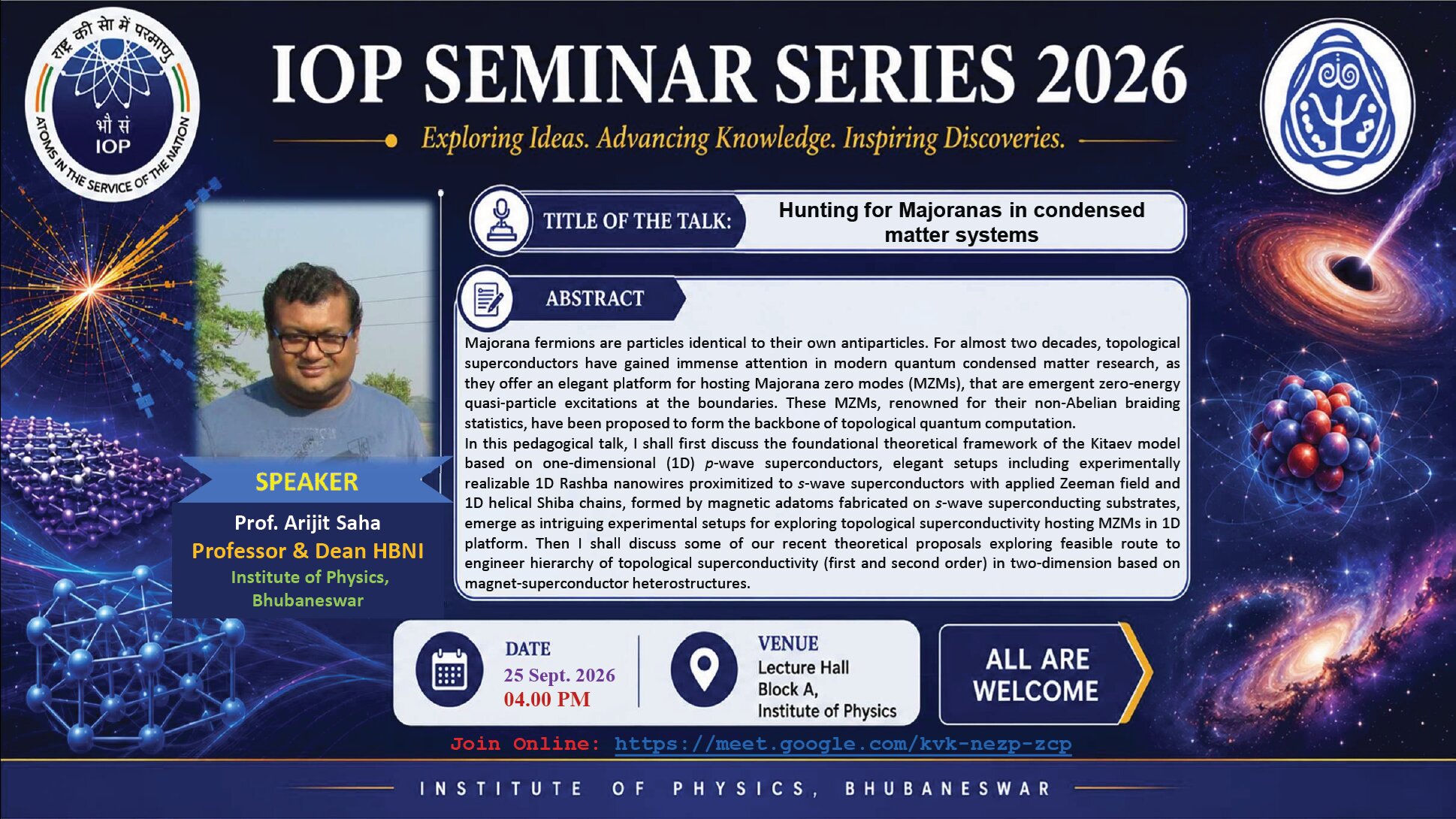
Lecture Hall, Block-A, Institute of Physics, Bhubaneswar
Document Date: 15/09/2026
Hunting for Majoranas in condensed matter systems
Hunting for Majoranas in condensed matter systems
Abstract:
Majorana fermions are particles identical to their own antiparticles. For almost two decades, topological superconductors have gained immense attention in modern quantum condensed matter research, as they offer an elegant platform for hosting Majorana zero modes (MZMs), that are emergent zero-energy quasi-particle excitations at the boundaries. These MZMs, renowned for their non-Abelian braiding statistics, have been proposed to form the backbone of topological quantum computation. In this pedagogical talk, I shall first discuss the foundational theoretical framework of the Kitaev model based on one-dimensional (1D) p-wave superconductors, elegant setups including experimentally realizable 1D Rashba nanowires proximitized to s-wave superconductors with an applied Zeeman field and 1D helical Shiba chains, formed by magnetic adatoms fabricated on s-wave superconducting substrates, emerge as intriguing experimental setups for exploring topological superconductivity hosting MZMs in a 1D platform. Then I shall discuss some of our recent theoretical proposals exploring a feasible route to engineer hierarchy of topological superconductivity (first and second order) in two dimensions based on magnet-superconductor heterostructures.
Lecture Hall, Block-A, Institute of Physics, Bhubaneswar
Document Date: 05/09/2026
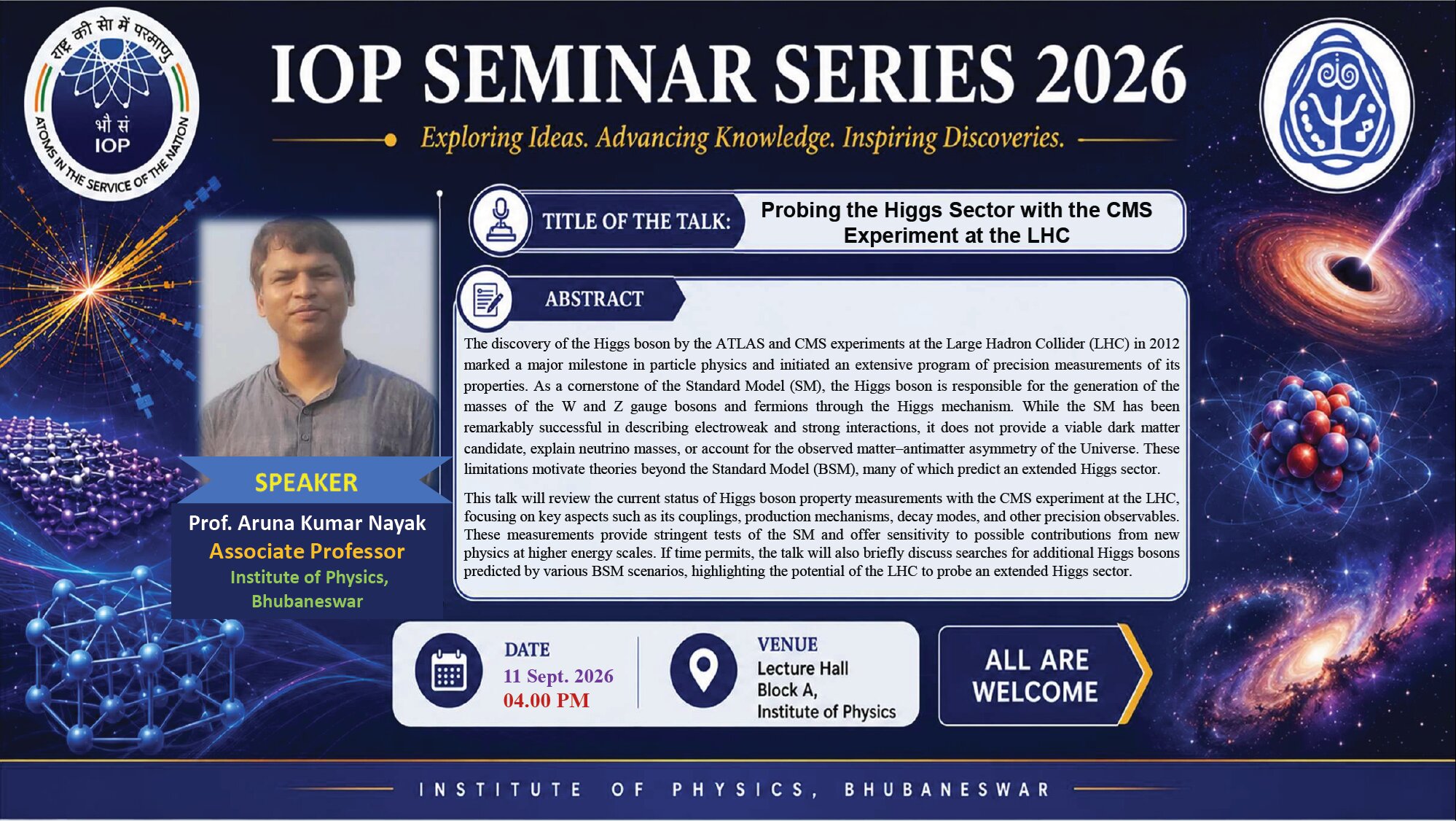
Probing the Higgs Sector with the CMS Experiment at the LHC
Probing the Higgs Sector with the CMS Experiment at the LHC
Abstract:
The discovery of the Higgs boson by the ATLAS and CMS experiments at the Large Hadron Collider (LHC) in 2012 marked a major milestone in particle physics and initiated an extensive program of precision measurements of its properties. As a cornerstone of the Standard Model (SM), the Higgs boson is responsible for the generation
of the masses of the W and Z gauge bosons and fermions through the Higgs mechanism. While the SM has been remarkably successful in describing electroweak and strong interactions, it does not provide a viable dark matter candidate, explain neutrino masses, or account for the observed matter–antimatter asymmetry of the Universe. These limitations motivate theories beyond the Standard Model (BSM), many of which predict an extended Higgs sector. This talk will review the current status of Higgs boson property measurements with the CMS experiment at the LHC, focusing on key aspects such as its couplings, production mechanisms, decay modes, and other precision
observables. These measurements provide stringent tests of the SM and offer sensitivity to possible contributions from new physics at higher energy scales. If time permits, the talk will also briefly discuss searches for additional Higgs bosons predicted by various BSM scenarios, highlighting the potential of the LHC to probe an extended Higgs sector.
Lecture Hall, Block-A, Institute of Physics, Bhubaneswar
Document Date: 20/08/2026
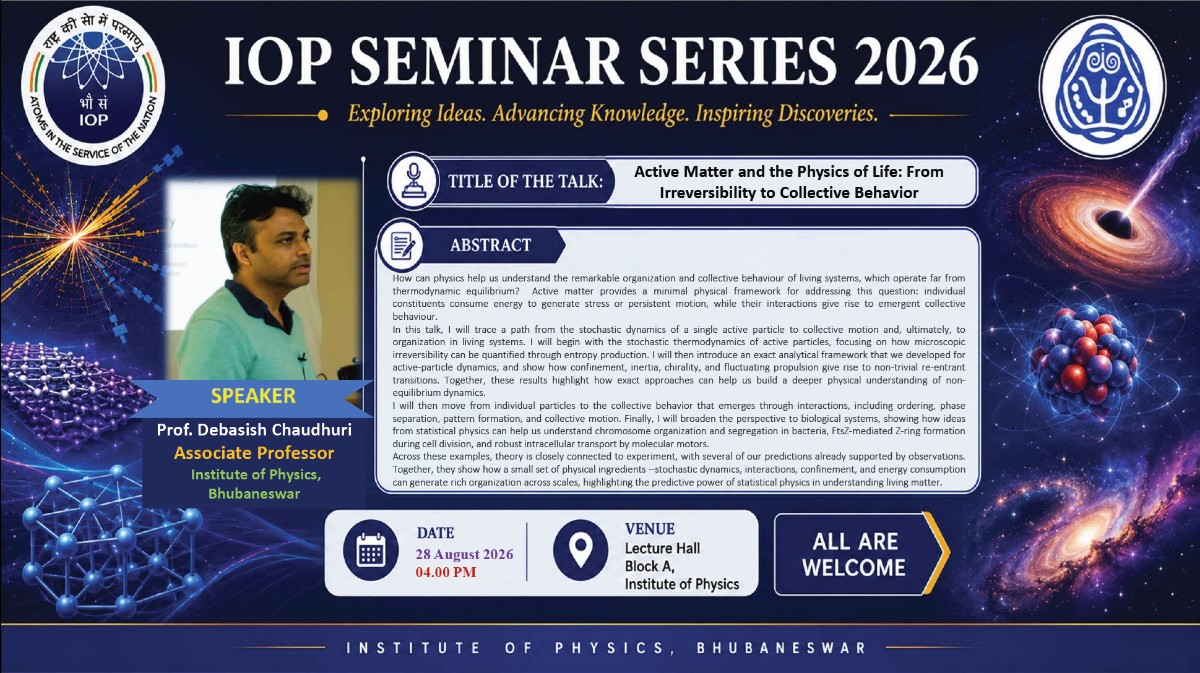
Active Matter and the Physics of Life: From Irreversibility to Collective Behaviour
Active Matter and the Physics of Life: From Irreversibility to Collective Behaviour
Abstract:
How can physics help us understand the remarkable organization and collective behaviour of living systems,
which operate far from thermodynamic equilibrium? Active matter provides a minimal physical framework for
addressing this question: individual constituents consume energy to generate stress or persistent motion,
while their interactions give rise to emergent collective behaviour.
In this talk, I will trace a path from the stochastic dynamics of a single active particle to collective motion
and, ultimately, to organization in living systems. I will begin with the stochastic thermodynamics of active
particles, focusing on how microscopic irreversibility can be quantified through entropy production. I will then
introduce an exact analytical framework that we developed for active-particle dynamics, and show how confinement,
inertia, chirality, and fluctuating propulsion give rise to non-trivial re-entrant transitions. Together, these
results highlight how exact approaches can help us build a deeper physical understanding of non-equilibrium dynamics.
I will then move from individual particles to the collective behaviour that emerges through interactions, including
ordering, phase separation, pattern formation, and collective motion. Finally, I will broaden the perspective to
biological systems, showing how ideas from statistical physics can help us understand chromosome organization and
segregation in bacteria, FtsZ-mediated Z-ring formation during cell division, and robust intracellular transport
by molecular motors.
Across these examples, theory is closely connected to experiment, with several of our predictions already supported
by observations. Together, they show how a small set of physical ingredients –stochastic dynamics, interactions,
confinement, and energy consumption — can generate rich organization across scales, highlighting the predictive
power of statistical physics in understanding living matter.
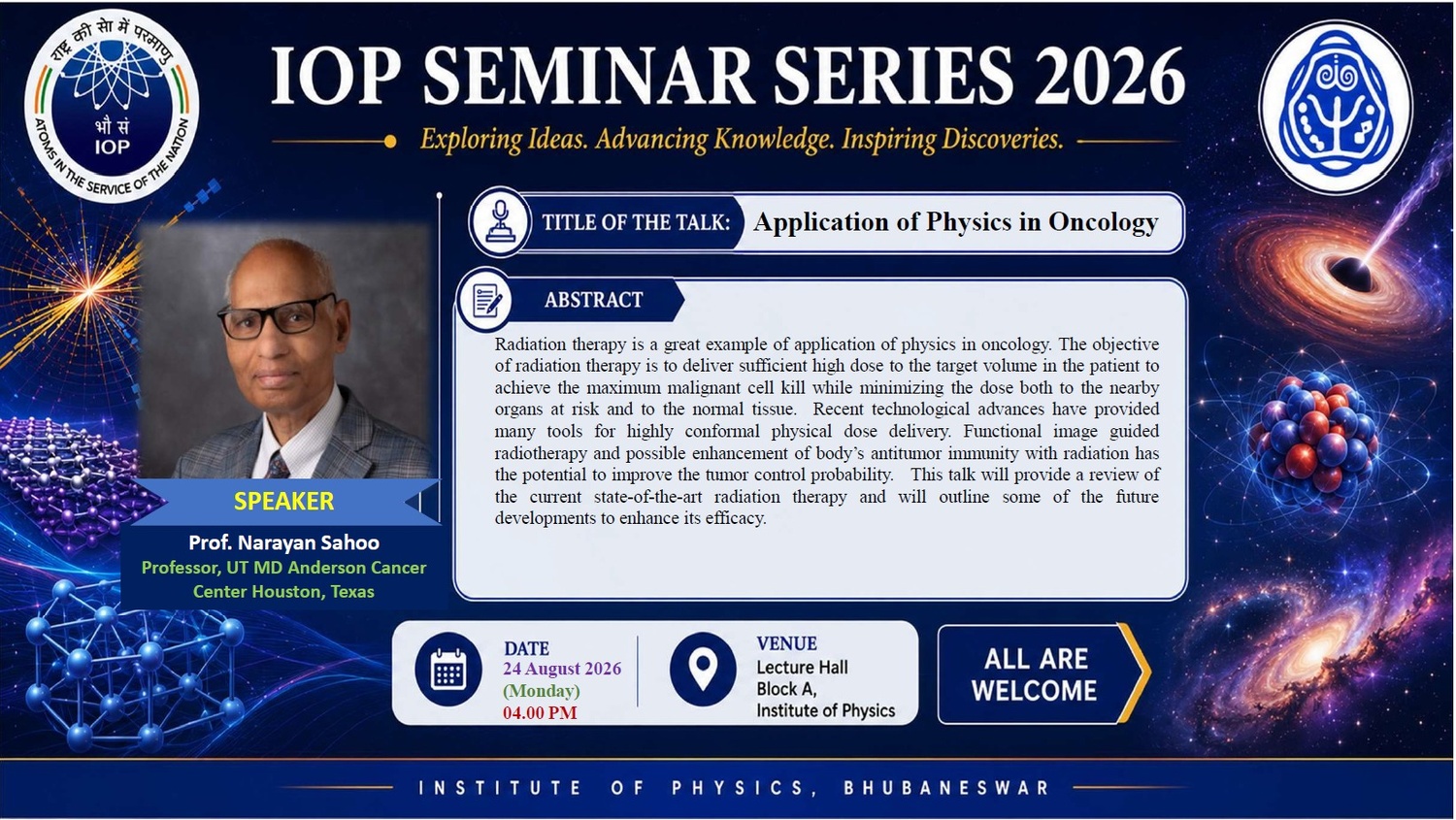
Prof. Narayan Sahoo, Department of Radiation Physics, UT MD Anderson Cancer Center Houston, Texas
Seminar
Lecture Hall, Block-A, Institute of Physics, Bhubaneswar
Document Date: 18/08/2026
Application of Physics in Oncology
Application of Physics in Oncology
Abstract:
Radiation therapy is a great example of the application of physics in oncology. The objective of radiation therapy is to deliver sufficient high dose to the target volume in the patient to achieve the maximum malignant cell kill while minimizing the dose both to the nearby organs at risk and to the normal tissue.
Recent technological advances have provided many tools for highly conformal physical dose delivery. Functional image-guided radiotherapy and possible enhancement of the body’s antitumor immunity with radiation have the potential to improve the tumour control probability. This talk will provide a review of the current state-of-the-art radiation therapy and will outline some of the future developments to enhance its efficacy.
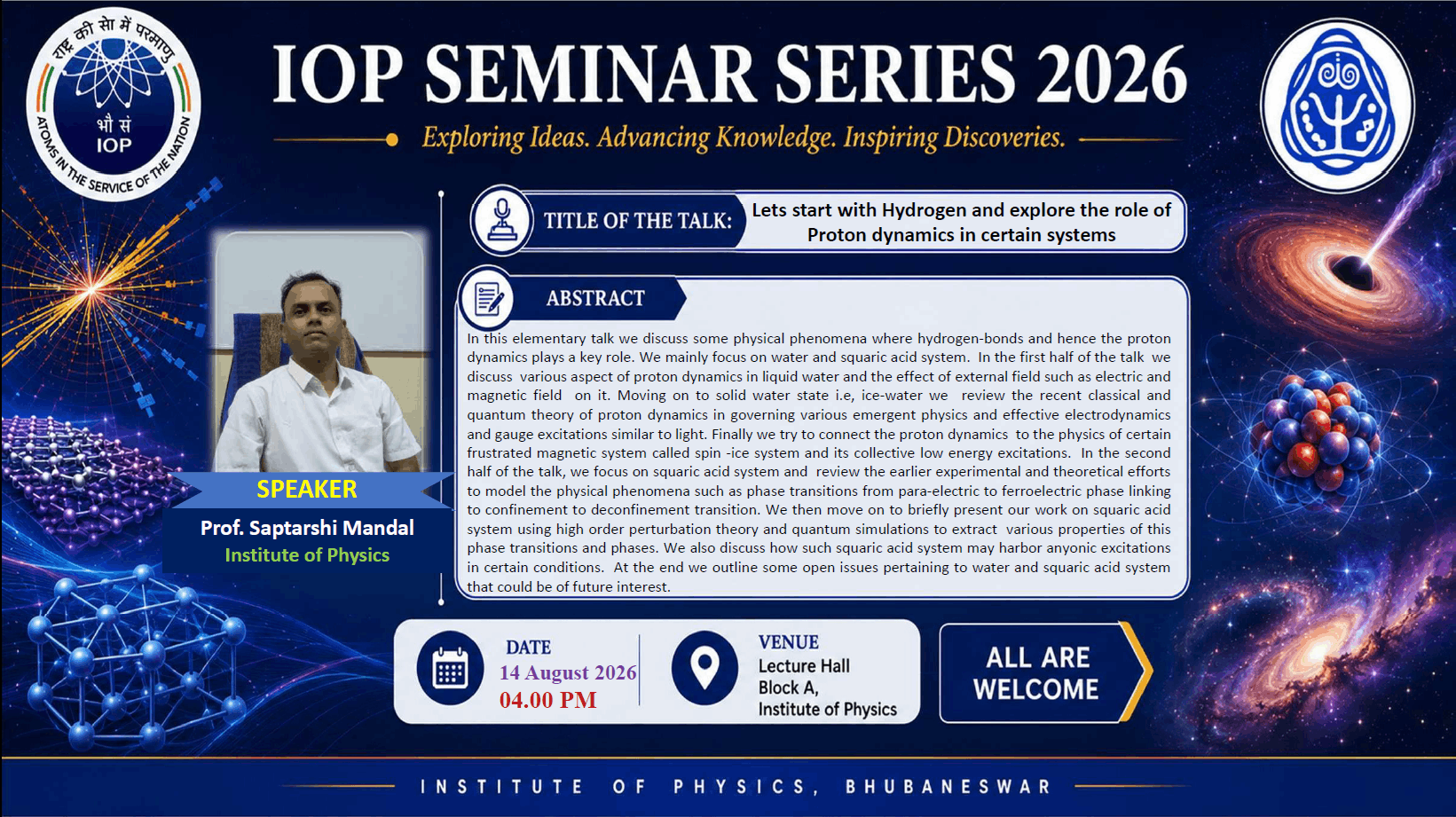
Lets start with Hydrogen and Explore the role of Proton dynamics in certain systems
Lets start with Hydrogen and Explore the role of Proton dynamics in certain systems
Abstract:
In this elementary talk, we discuss some physical phenomena where hydrogen-bonds and hence proton dynamics play a key role. We mainly focus on the water-and-squaric acid system. In the first half of the talk, we discuss various aspects of proton dynamics in liquid water and the effect of external fields such as electric and magnetic fields on it. Moving on to the solid water state, i.e ice-water we review the recent classical and quantum theory of proton dynamics in governing various emergent physics and effective electrodynamics and gauge excitations similar to light. Finally, we try to connect the proton dynamics to the physics of a certain frustrated magnetic system called spin-ice system and its collective low-energy excitations. In the second half of the talk, we focus on squaric acid system and review the earlier experimental and theoretical efforts to model the physical phenomena such as phase transitions from para-electric to ferroelectric phase linking to confinement to deconfinement transition. We then move on to briefly present our work on squaric acid system using high-order perturbation theory and quantum simulations to extract various properties of these phase transitions and phases. We also discuss how such squaric acid system may harbor anyonic excitations in certain conditions. At the end, we outline some open issues about the water and squaric acid system that could be of future interest.
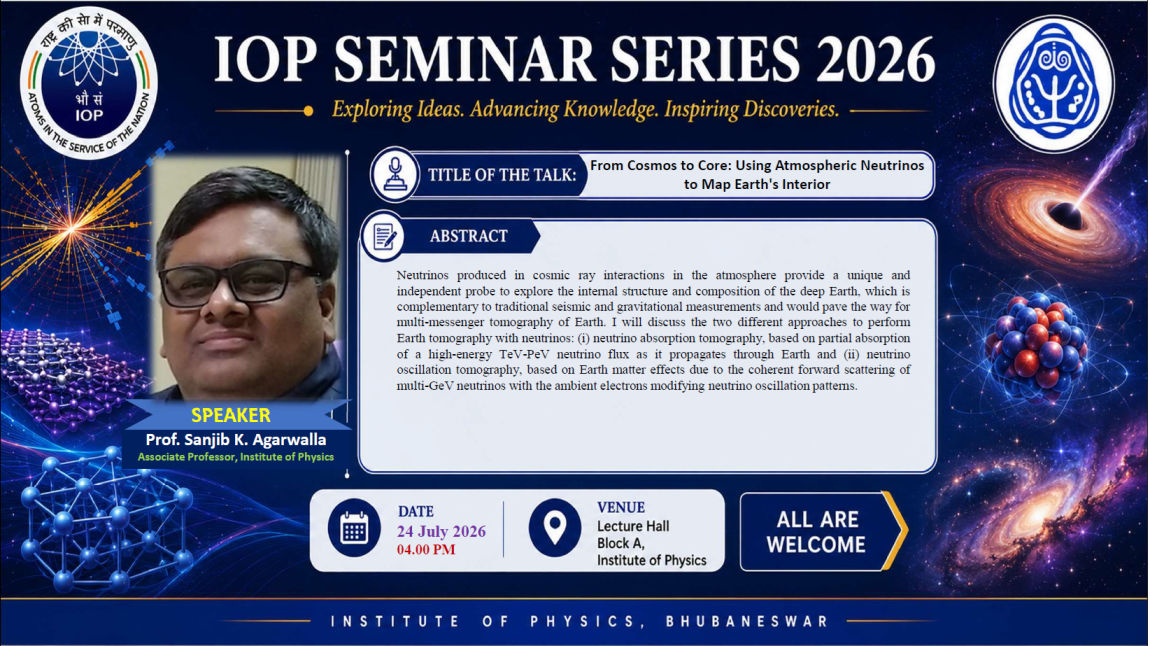
From Cosmos to Core: Using Atmospheric Neutrinos to Map Earth’s Interior
From Cosmos to Core: Using Atmospheric Neutrinos to Map Earth’s Interior
Abstract:
Neutrinos produced in cosmic ray interactions in the atmosphere provide a unique and independent probe to explore the internal structure and composition of the deep Earth, which is complementary to traditional seismic and gravitational measurements and would pave the way for multi-messenger tomography of Earth. I will discuss the two different approaches to perform Earth tomography with neutrinos: (i) neutrino absorption tomography, based on partial absorption of a high-energy TeV-PeV neutrino flux as it propagates through Earth and (ii) neutrino oscillation tomography, based on Earth matter effects due to the coherent forward scattering of multi-GeV neutrinos with the ambient electrons modifying neutrino oscillation patterns.




 22/10/2026