Physics of life:Active and living matter (PoL24)
-
ORGANIZERS
Abhishek Chaudhuri (IISER Mohali), Debasish Chaudhuri (IOP Bhubaneswar)
DATE
08 - 10 Feb 2024
VENUE
Toshali Sands, Puri
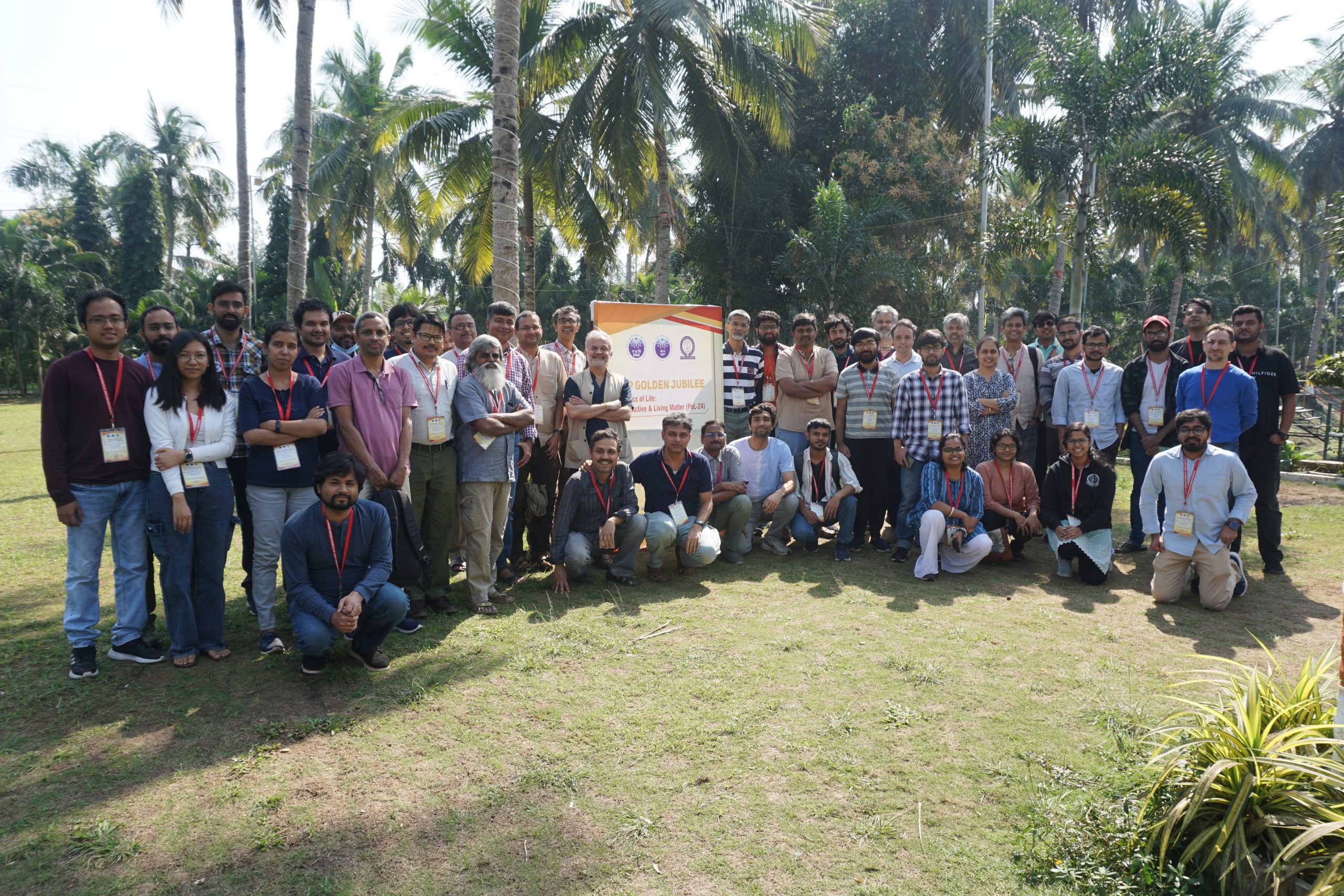
The workshop on “Physics of life: Active and living matter (PoL24)” is a part of the Golden Jubilee celebration of the Institute of Physics, Bhubaneswar. The conference is co-organized by the Indian Institute of Science Education and Research, Mohali (IISER Mohali). Research in active systems, both natural and artificial, is developing quickly. In order to comprehend and address biological issues, fundamental physics principles have been used, and artificial active systems have opened up new possibilities for emergent phenomena. New experimental findings question the early theories, and novel theoretical ideas illuminate various collective processes. We want to provide an environment where theorists and experimentalists can interact and share their viewpoints on active systems. In this fascinating topic, we’ll concentrate on exchanging ideas involving novel experiments, models, and emergent states. With this workshop, we hope to bring together a diverse and active group of scientists to exchange ideas.
| Days/Times | Day-1 (7 Feb) | Day-2 (8 Feb) | Day-3 (9 Feb) | Day-4 (10 Feb) |
|---|---|---|---|---|
| 09:00-9:30 | Shashi Thutupalli tba |
Madan Rao Mechanically excitable active epithelia |
||
| 09:30-10:00 | Fernando Peruani Challenges in Active Matter |
Arnab Saha Microscopic Heat Engines: From Passive to Active |
Vijaykumar Krishnamurthy Physics of asymmetric cytokinetic ingression |
|
| 10:00-10:30 | Prasad Parlekar Concentration wave turbulence in polar active matter |
Pinaki Chaudhuri Active breathing: a micro-meso analysis |
Anirban Sain Active chiral flows during cell division |
|
| 10:30-11:00 | Sumesh P Thampi Spontaneous flow transitions in confined active nematics |
Saroj Nandi The glassy dynamics in confluent epithelial monolayers |
Amitabha Nandi Kinesin-mediated axonal transport of vesicles |
|
| 11:00-11:30 | TEA |
TEA |
TEA |
|
| 11:30-12:00 | Raja Paul Flocking transition in discretized Vicsek model |
Sunil Kumar Vesicle morphology changes through active membrane recycling |
Vijaykumar Chikkadi Nonequilibrium assembly of colloidal particles in active liquids |
|
| 12:00-12:30 | Abhik Basu Mobility-induced order in active XY spins on a substrate |
Snigdha Thakur Dynamics of Flexible Active Polymer |
Shraddha Mishra Micro-swimmers Unveil Novel Dynamical Phase in Active Nematics |
|
| 12:30-13:00 | Subir K Das Kinetics of Phase Transitions in Systems of Aligning Active Particles |
Raghunath Chelakkot Dynamic patterns due to follower activity in particle chains |
Kabir Ramola Current Fluctuations in Interacting and Non-interacting Active Particle Systems |
|
| 13:00-13:30 | Lunch | Lunch | Lunch | |
| 13:30-14:00 | Lunch + poster |
Lunch | Lunch + poster | |
| 14:00-14:30 | poster | Sudipto Muhuri Effect of contact inhibition locomotion on confined cellular organization |
poster | |
| 14:30-15:00 | Sanjib Sabhapandit Novel features of direction reversing active Brownian particle |
Subhajit Paul Dynamical Crossovers and Correlations in a Linear Chain of Active Particles |
P K Mohanty Interactive active matter |
|
| 15:00-15:30 | Urna Basu Activity reservoirs and energy transport in one-dimension |
TEA | Punyabrata Pradhan Time-dependent properties of hardcore run-and-tumble particles |
|
| 15:30-16:00 | Anupam Kundu Active dynamics at microscopic level |
Discussion | Arnab Pal Anomalous relaxation in active systems |
|
| 16:00-16:30 | TEA | Discussion | Vote of thanks | |
| 16:30-17:00 | Pramod Pullarkat Actin dynamics and force generation in membrane nanotubes |
Discussion | High TEA | |
| 17:00-17:30 | Ramanujam Srinivasan Assembly of bacterial cytokinetic ring proceeds via a helical intermediate and is driven by treadmilling and lateral association of filaments |
Discussion | ||
| 17:30-18:00 | Welcome address and inauguration by the Director, IOP | Sabyasachi Rakshit Dynamics of autonomous chiral active GUVs |
poster | |
| 18:00-18:30 | High Tea | Sathish Akella The Narrow Escape Problem of a Chiral Active Particle (CAP): An Optimal Scheme |
||
| 18:30-19:00 | poster | |||
| 19:00-19:30 | Welcome Dinner | Dinner | Dinner |
| SI. No. | Name | Affiliation |
|---|---|---|
| 1 | Sathish Akella | Indian Institute Of Technology Jammu, India |
| 2 | Abhik Basu | Saha Institute of Nuclear Physics, India |
| 3 | Urna Basu | S. N. Bose National Centre for Basic Sciences, India |
| 4 | Pinaki Chaudhuri | Institute of Mathematical Sciences Chennai, India |
| 5 | Raghunath Chelakkot | Indian Institute of Technology Bombay, India |
| 6 | Vijaykumar Chikkadi | Indian Institute of Science Education and Research Pune, India |
| 7 | Debashish Chowdhury | DIT University, India |
| 8 | Subir K Das | Jawaharlal Nehru Centre For Advanced Scientific Research, India |
| 9 | Vijaykumar Krishnamurthy | International Centre for Theoretical Sciences, India |
| 10 | P B Sunil Kumar | Indian Institute of Technology Madras, India |
| 11 | Anupam Kundu | International Centre for Theoretical Sciences, India |
| 12 | Shraddha Mishra | Indian Institute of Technology (BHU) Varanasi, India |
| 13 | P K Mohanty | Indian Institute of Science Education and Research Kolkata, India |
| 14 | Sudipto Muhuri | Pune University, India |
| 15 | Amitabha Nandi | Indian Institute of Technology Bombay, India |
| 16 | Saroj Nandi | Tata Institute of Fundamental Research Hyderabad, India |
| 17 | Ignacio Pagonabarraga | University of Barcelona, Spain |
| 18 | Arnab Pal | Institute of Mathematical Sciences Chennai, India |
| 19 | Prasad Parlekar | Tata Institute of Fundamental Research Hyderabad, India |
| 20 | Raja Paul | Indian Association for the Cultivation of Science Kolkata, India |
| 21 | Subhajit Paul | University of Delhi, India |
| 22 | Fernando Peruani | LPTM, CY-Cergy Paris University, France |
| 23 | Punyabrata Pradhan | S. N. Bose National Centre for Basic Sciences, India |
| 24 | Pramod A Pullarkat | Raman Research Institute, India |
| 25 | Sabyasachi Rakshit | Indian Institute of Science Education and Research Mohali, India |
| 26 | Kabir Ramola | Tata Institute of Fundamental Research Hyderabad, India |
| 27 | Madan Rao | National Centre for Biological Sciences, India |
| 28 | Sanjib Sabhapandit | Raman Research Institute, India |
| 29 | Arnab Saha | University of Calcutta, India |
| 30 | Anirban Sain | Indian Institute of Technology Bombay, India |
| 31 | R Srinivasan | National Institute of Science Education and Research Bhubaneswar, India |
| 32 | Snigdha Thakur | Indian Institute of Science Education and Research Bhopal, India |
| 33 | Sumesh P Thampi | Indian Institute of Technology Madras, India |
| 34 | Shashi Thutupalli | National Centre for Biological Sciences, India |
How to Reach
There are a few options to reach Toshali Sands from Bhubaneswar Airport/ Railway Station

Bhubaneswar Railway Station to IOPB 6km.

Bhubaneswar Airport to IOPB 7.7km.

Bhubaneswar Bus Stand to IOPB 7.6km.