Nobel Prize in Physics 2026 has been awarded to Professor Francis Halzen of the University of Wisconsin-Madison
Nobel Prize in Physics 2026 has been awarded to Professor Francis Halzen of the University of Wisconsin-Madison
Celebrating the Nobel Prize in Physics 2026 and a Landmark Achievement in Neutrino Physics
The Royal Swedish Academy of Sciences has decided to award the Nobel Prize in Physics 2026 to Professor Francis Halzen of the University of Wisconsin–Madison, “for decisive contributions to the IceCube Neutrino Observatory and the discovery of high-energy neutrinos of astrophysical origin.”
Prof. Francis Halzen is the founder and Principal Investigator of the IceCube Neutrino Observatory, a pioneering neutrino telescope located at the South Pole. Embedded deep within the Antarctic ice, IceCube detects the faint Cherenkov light produced by charged particles generated when neutrinos interact in the ice. The observatory has opened an entirely new window to the Universe by detecting high-energy neutrinos of astrophysical origin and has played a pioneering role in the development of multi-messenger astronomy. Among IceCube’s landmark discoveries are the identification of neutrinos from sources such as the Blazar TXS 0506+056, the Seyfert galaxy NGC 1068, and the galactic plane of the Milky Way.
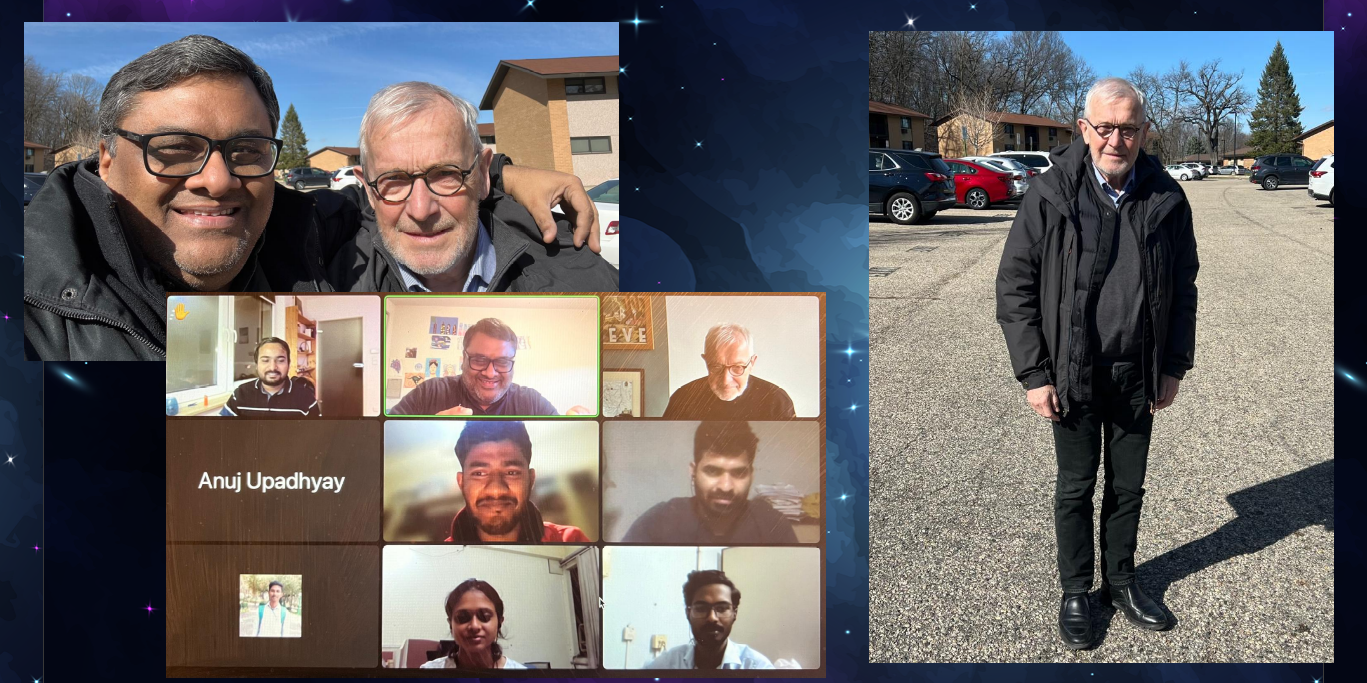
Prof. Sanjib Kumar Agarwalla and his group at the Institute of Physics (IOP), Bhubaneswar, are proud to have worked closely with Prof. Francis Halzen as members of the IceCube Collaboration through the University of Wisconsin-Madison. The group’s involvement in IceCube has greatly enriched their understanding of neutrino physics and provided valuable opportunities to contribute to neutrino oscillation studies using IceCube DeepCore. As part of the IceCube Collaboration, the group has been actively involved in exploring the interior of the Earth using atmospheric neutrinos, with IceCube DeepCore and the IceCube Upgrade. Neutrino tomography of the Earth is an emerging interdisciplinary field that uses neutrinos as unique probes of Earth’s interior, connecting particle physics and neutrino physics with Earth and geophysical sciences. Recently, the neutrino group at IOP has performed several in-house analyses of publicly available IceCube DeepCore data to constrain various new physics scenarios, such as nonstandard neutrino interactions, long-range neutrino interactions, and non-unitary neutrino mixing.
We are delighted to celebrate this historic recognition of the scientific vision and contributions of Prof. Francis Halzen. We extend our heartfelt congratulations to Prof. Francis Halzen and to the entire IceCube Collaboration on this remarkable and well-deserved achievement.
Prof. Manmath Kumar Badapanda on the IETE-Bimal Bose Award 2026
Prof. Manmath Kumar Badapanda on the IETE-Bimal Bose Award 2026
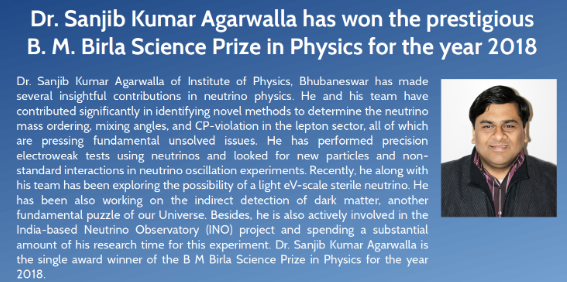
Dr. Sanjib Kumar Agarwalla gets B. M. Birla Science Prize 2018.
Dr. Sanjib Kumar Agarwalla gets B. M. Birla Science Prize 2018.
Dr. Sanjib Kumar Agarwalla has been awarded the prestigious DST Swarnajayanti Fellowship 2019-2020
Dr. Sanjib Kumar Agarwalla has been awarded the prestigious DST Swarnajayanti Fellowship 2019-2020
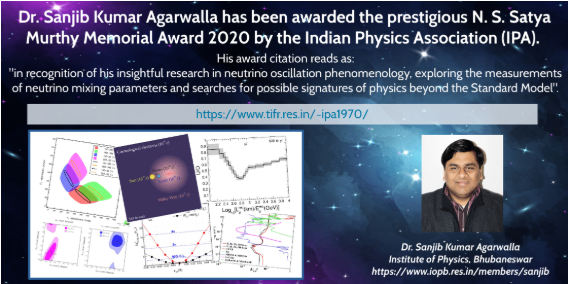
Dr. Sanjib Kumar Agarwalla has been selected for the prestigious N. S. Satya Murthy Award 2020 by the Indian Physics Association
Dr. Sanjib Kumar Agarwalla has been selected for the prestigious N. S. Satya Murthy Award 2020 by the Indian Physics Association
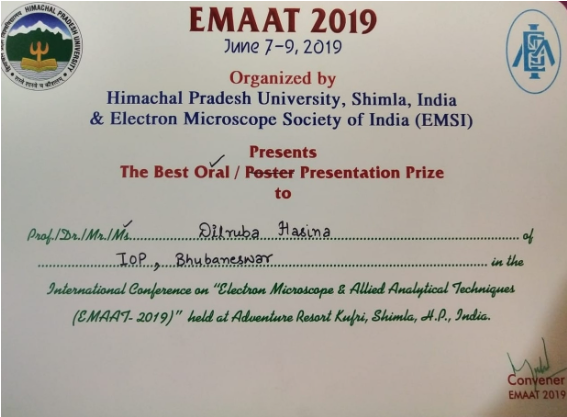
Ms. Dilruba Hasina won 1st prize in oral presentation in the International Conference on “Electron Microscopy and Allied Analytical Techniques(EMAAT 2019)” organized by Himachal Pradesh...
Ms. Dilruba Hasina won 1st prize in oral presentation in the International Conference on “Electron Microscopy and Allied Analytical Techniques(EMAAT 2019)” organized by Himachal Pradesh University, Shimla, India and Electron Microscope Society of India (EMSI).
Ms. Dilruba Hasina won 1st prize in oral presentation in the International Conference on “Electron Microscopy and Allied Analytical Techniques(EMAAT 2019)” organized by Himachal Pradesh...
Ms. Dilruba Hasina won 1st prize in oral presentation in the International Conference on “Electron Microscopy and Allied Analytical Techniques(EMAAT 2019)” organized by Himachal Pradesh University, Shimla, India and Electron Microscope Society of India (EMSI).
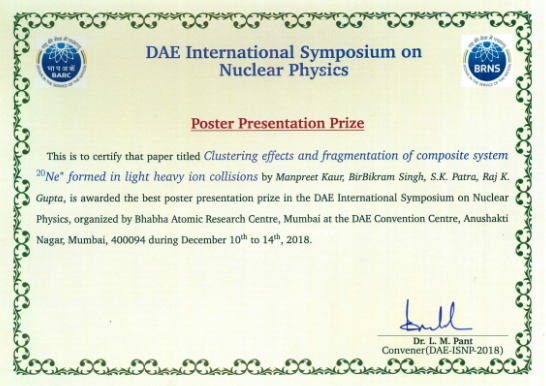
Dr. Manpreet Kaur won best poster award in “International DAE Symposium on Nuclear Physics 2018” held at B.A.R.C., Mumbai for her paper – Clustering effects...
Dr. Manpreet Kaur won best poster award in “International DAE Symposium on Nuclear Physics 2018” held at B.A.R.C., Mumbai for her paper – Clustering effects and fragmentation of composite system 20Ne* formed in light heavy ion collisions.
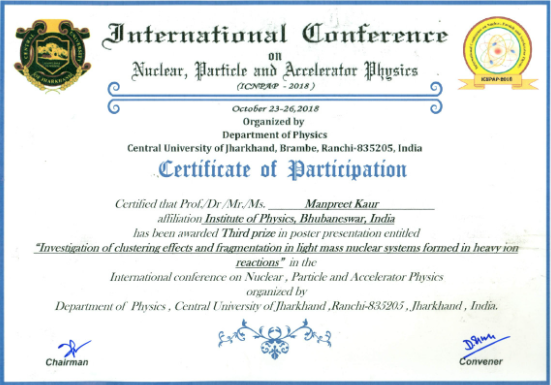
Dr. Manpreet Kaur won 3rd best poster award in “International Conference on Nuclear, Particle and Accelerator Physics (ICNPAP2018)” held at Central University of Jharkhand, Ranchi...
Dr. Manpreet Kaur won 3rd best poster award in “International Conference on Nuclear, Particle and Accelerator Physics (ICNPAP2018)” held at Central University of Jharkhand, Ranchi for her paper – Investigation of clustering effects and fragmentation in light mass nuclear systems.




 22/10/2026